Long-duration Digital Home Cage Phenotyping Greatly Enhances Reproducibility of Behavioral Studies
DIVA Poster at 2025 Society for Neuroscience
Nov 15-19, 2025
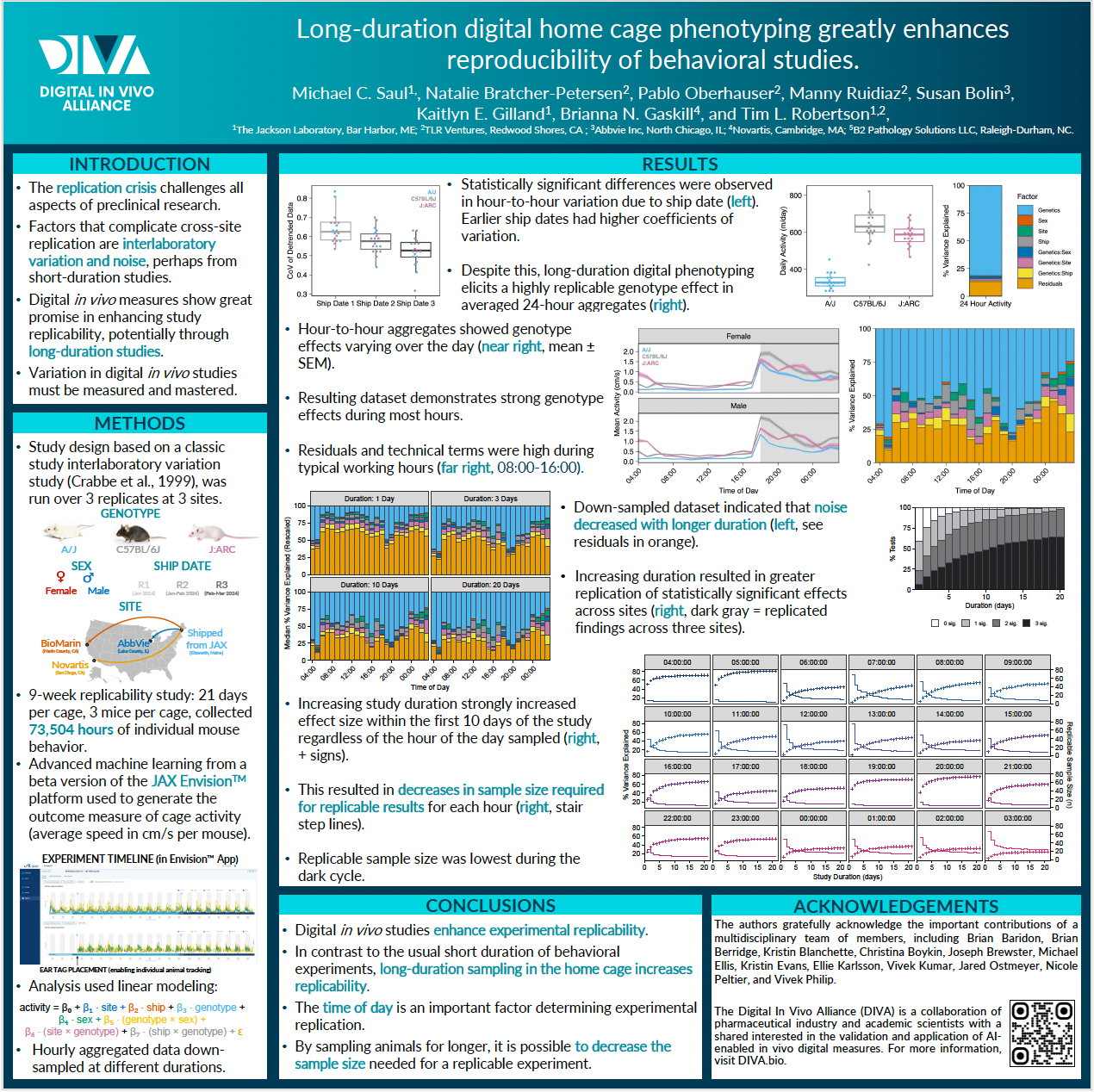
Interlaboratory variation and noise challenge reproducibility, undermining confidence in preclinical behavioral neuroscience findings. Mastering the inherent variability in behavioral phenotypes holds significant scientific value, potentially improving reproducibility and translational success. New strategies are needed to understand and overcome this variability rather than eliminate it.Using a novel digital home cage phenotyping system called Envision™ by JAX, we examined the interplay between individual variability; biological factors such as genotype and sex; and technical factors such as temporal replicate, study duration, and site. We adapted the study methodology from a classic study on interlaboratory variation, but leveraged digital home cage measures as novel outcomes. We collected 21 days of digital home cage activity data for both sexes of three different mouse genotypes (A/J, C57BL/6J, and J:ARC(S)) at three different sites and over three different temporal replicates. We hypothesized that genotype would be the predominant biological contributor to phenotype, but with unknown contributions from technical factors and noise. The study documented 76,495 hours of mouse life. The video data were processed using novel machine vision algorithms and cage-level activity was extracted from the datasets. The results indicate that variation strongly manifests at granular temporal resolutions. However, when analyzing the aggregated data, averaging over extended durations greatly increased the signal-to-noise ratio and allowed us to detect large genotype effect sizes. Further, we found that the signal-to-noise ratio varies by the time of measurement. By combining long duration phenotyping of 10+ days with 24-hour data capture, the sample sizes needed for replicable results were greatly reduced as indicated by power analysis. These results demonstrate that long duration studies, where data are collected continuously in the home cage, are able to capture and overcome individual variation. The results also highlight how digital tools enable replication, enhance generalizability, and may ultimately improve translational outcomes in drug development. By integrating digital in vivo behavioral measures across domains such as neuromotor disease, epilepsy, and safety pharmacology, we can improve the fidelity of preclinical models to human conditions.
This work was funded by the Digital In Vivo Alliance
Download the Poster Below